
Break Into AI Testing
Live (Zoom) • Intermediate • 5 Weeks
Part of AI Accelerator
Break Into AI Testing
You are not behind — you have been sold courses instead of proof. Five weekends, one real AI product, and an eval report you can put in front of any hiring manager.

Duration
5 Weeks
Prerequisites
1+ yrs experience in QA
Background
No Coding Required
Format
Live, 95% Hands-on
Upcoming
Cohort October 2026
Start Date: October 17, 2026
End Date: November 15, 2026
Duration: 5 Weeks
Format: Interactive live Zoom sessions


Pricing
$3,997
$4,997
Early bird price until October 1
or Buy Now, Pay Later with  (only for United States)
by paying, you agree to the Terms & Conditions
Course Schedule (PDT)
October 17
Saturday
10:00 AM - 2:00 PM
October 18
Sunday
10:00 AM - 2:00 PM
October 24
Saturday
10:00 AM - 2:00 PM
October 25
Sunday
10:00 AM - 2:00 PM
October 31
Saturday
10:00 AM - 2:00 PM
November 1
Sunday
10:00 AM - 2:00 PM
November 7
Saturday
10:00 AM - 2:00 PM
November 8
Sunday
10:00 AM - 2:00 PM
November 14
Saturday
10:00 AM - 2:00 PM
November 15
Sunday
10:00 AM - 2:00 PM
This Is If
- You are a QA or SDET and you want to own AI testing before someone else on your team does.
- You automate tests, and Selenium and Playwright are no longer the ceiling you want.
- You test manually, have never written production code, and are ready to learn hands-on.
- You lead QA, and you own the risk when an AI feature ships with nobody signing off.
- You engineer software and you are circling prompt engineering or AI quality roles.
“I know how to test APIs and UIs… but AI apps feel different.”
→ This path bridges that gap.

You Can't Learn To Test AI By Someone Test AI.
LLM Behavior Testing
Prompt injection, jailbreaks, hallucination detection, context window limits

Evaluation Frameworks
Build automated evals with Promptfoo, custom metrics, and assertion suites

Bias & Fairness Auditing
Identify and document model bias across demographics and edge cases

Safety & Red-teaming
Adversarial testing, compliance checks, and responsible AI validation

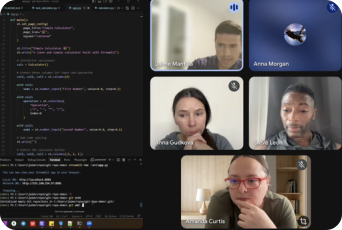
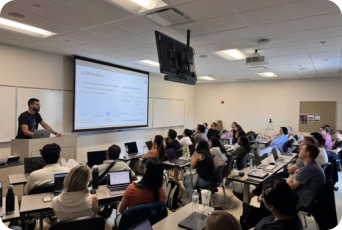
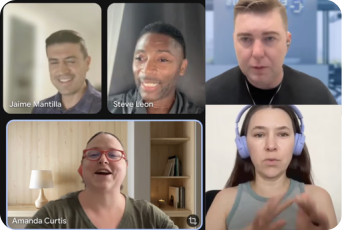
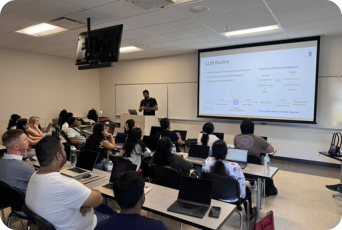
157 QA Engineers Have Already Made The Move
Taught By Engineers Who

CEO and Founder
Igor founded Engenious.io and has 15+ years in software testing. He has worked at Barnes & Noble, Expedia and Tinder, and consulted at Apple and Grammarly. He teaches the career week — positioning, outreach and the interview questions companies are actually asking.

Senior iOS Engineer to Co-Founder & CTO·WeOptimize.ai
Vladimir is an experienced engineer with 8+ years in iOS/macOS development, specializing in AI-powered solutions. As the Co-Founder & CTO of WeOptimize.ai, he leverages AI to optimize workflows and enhance productivity. He has a track record of delivering innovative products for both startups and large enterprises.

Award Winning Leader in Quality Assurance
Visionary QA Leader with substantial experience in the IT industry. Worked across Salesforce, Sony, and now as part of Video Engineering and Quality Assurance at Fox Media, he leads the strategy for high-concurrency streaming environments, where a single second of latency is unacceptable.

Quality Engineering Manager
Seasoned IT professional with 14+ years of experience in Software Engineering, Quality Assurance, and Automation. Skilled in leading teams, designing test strategies, and building automation frameworks across diverse industries. Adept at leveraging modern tools, AI-driven testing approaches, and cloud technologies to deliver high-quality, scalable solutions. Holds a Bachelor’s in Management Information Systems and a Master’s in Information Technology with proven success supporting enterprise-level clients and Fortune 500 companies.

Founder of Lemonade Tech & QA Manager
Amanda Curtis is a QA leader and founder of Lemonade Tech, with a passion for responsible AI adoption and helping teams cut through tech overwhelm. With 10+ years experience leading QA teams and modernizing testing practices, Amanda focuses on practical solutions that improve software quality while keeping technology approachable and human-centered. Helping organizations “find the good in tech” by cutting through complexity and focusing on what truly adds value.

Instructor AI Accelerator
Software development and QA experience for over 20 years. Alex has worked at well-known companies such as Oracle and HCL Software, and has strong expertise in functional, regression, and automated testing, complemented by a background in Java-based application development. Skilled in WebdriverIO, Selenium, JavaScript, and CI/CD pipelines, with hands-on experience in building and supporting enterprise applications.

Software Engineer
10 years of experience in the tech industry; Senior Android Engineer in Platform team. Expert in CI/CD pipelines, test automation, and mobile infrastructure; passionate about developer productivity and workflow optimization.

Instructor AI Accelerator
Quality Engineering leader driving scalable automation and delivery across enterprise SaaS and AI/LLM systems. Leads global QA teams and embeds quality into revenue-critical release pipelines, strengthening reliability and trust in AI-driven products.
Who You Become in 5-weeks
01
Week
Day 1: AI Fundamentals and Tool Setup
Introduction: Course rules, setting up the permanent Discord community channel. Theory: LLM basics, transformer architecture, differences between traditional software testing and AI system testing.
Hands-on: Environment setup (local and cloud models). Initial interactive model exploration comparing local (LM Studio) and commercial (OpenAI, Anthropic) models using the same prompt. Vulnerabilities: Introduction to the seven unique AI testing challenges (e.g., security, hallucination, bias).
Homework: Complete environment setup and design 3+ test prompts targeting the vulnerabilities.
Day 2: PromptFoo Basics
Tool Introduction: Learning PromptFoo for systematic AI testing. Shift to hands-on, Q&A, and group exercises (minimal presentations).
Configuration: Overview of PromptFoo's configuration (YAML structure), including providers (LLMs), prompts, and initial deterministic assertions (pass/fail checks). Practice utilizing variables within prompts.
Integration: Testing commercial and local models via PromptFoo.
Homework: Practice building test suites and reviewing assertions documentation.
02
Week
Day 3: Prompt Engineering and Cost Evaluation
Prompt Engineering: Defining the rules and constraints of the system (System Prompt) and crafting effective test inputs (User Prompt). Using AI (LLMs) to generate effective test prompts.
Evaluation: Hands-on workshop on LLM cost evaluation (budgeting) by running prompts against multiple models to compare cost per request.
Organization: Structuring the testing framework using file-based prompt configurations.
Day 4: Advanced Assertion & Career Prep
Advanced Testing: Deep dive into assertions, particularly Model-Graded Assertions (MGA), where an LLM acts as a judge (LLM Rubric) to evaluate output quality (relevancy, factuality). Testing using CSV-based files for structured test data.
Career Start: Introduction to LinkedIn Personal Branding; documenting early achievements and incorporating AI testing keywords (e.g., prompt engineering, LLM testing) to profiles.
Homework: Review PromptFoo Red Teaming documentation.
03
Week
Day 5: Red Teaming Concepts
Equator Point: Course halfway review.
Red Teaming: Defining red teaming as simulating adversarial inputs (like a comprehensive baseline report) to find vulnerabilities (e.g., security, bias). Discussion of vulnerability frameworks like the OWASP Top 10 for AI.
Strategy: Understanding Red Teaming workflow (defining strategy, execution, analysis) and configurations. Comparison of red teaming types (Small, Large, XXL/Extensive).
Day 6: Testing a Real Application (Red Team Web App)
Application Architecture: Reviewing the high-level architecture of the application (Orchestrator, Guard LLM, specialized LLMs, knowledge bases like Jira/Confluence/Figma).
Testing Mode: Focusing on end-to-end black box exploratory testing via the application's chat interface. Using the provided "Source of Truth" as acceptance criteria.
Bug Reporting: Hands-on exercise reporting and documenting bugs, including reproduction steps and linking them to specific AI vulnerabilities.
04
Week
Day 7: Red Teaming Execution & Triage
Application Setup: Finalizing the Red Teaming configuration by inputting a comprehensive application context (main purpose, features, system rules) into PromptFoo.
Group Triage: Teams exchange reported bugs and attempt to reproduce and validate issues found by classmates.
Advanced Testing: Hands-on session applying PromptFoo for complex scenarios, including multi-turn conversation testing using JSON objects for regression.
Tool Exposure: Alternative testing tool.
Day 8: Tool Exploration & Post-Launch Monitoring
Post-Launch Tools: Demo and discussion of tools used for monitoring and maintaining LLM models pre- and post-launch (e.g., Arato wrapper).
New Tool Assignment: Introduction to Agenta (a comparable, alternative LLM testing platform).
Homework: Explore and evaluate Agenta to apply foundational testing concepts learned from PromptFoo. Research other AI testing tools in the market (consulting mindset).
05
Week
Day 9: Agenta Review & LinkedIn Strategy
Tool Comparison: Reviewing homework findings on Agenta, applying foundational concepts (Evals, variables) learned from PromptFoo to a new platform.
Career Branding: Strategies for content creation and influence building on LinkedIn. Using generative AI tools (e.g., Claude, ChatGPT) as brainstorming partners for posts, while avoiding generic copy-paste content.
Accomplishments: Workshop focused on drafting AI LLM testing accomplishment statements for resumes/profiles, quantifying the business impact of skills learned.
Homework: Post tailored AI testing content on LinkedIn and engage (comment/repost) with classmates' posts.
Day 10: Final Optimization & Interview Prep
Final Profile Optimization: Updating LinkedIn profiles and resumes with core AI testing skills (prompt engineering, red teaming, hallucination detection, token consumption).
Interview Preparation: Review of common AI testing interview questions (e.g., scaling tests, verifying factual responses, token consumption, security, testing LLMs with other LLMs).
Wrap-up: Final remarks, community engagement commitment, and discussion of post-course resources.
You, After The Five Weeks

AI Evaluation Engineer
AI and LLM testing experience on a real U.S. startup product — plus the eval report that proves it.
$98K–$230K+
US market range
Skills
Tools
 Promptfoo
 LM Studio
 Agenta
 Arato.ai
 OpenAI API
 Anthropic API
AI Application Testing Portfolio
Hands-on artefacts covering LLM evaluation, prompt injection and jailbreak testing, multi-model comparison and hallucination detection — built with Promptfoo, the OpenAI and Anthropic APIs, and LM Studio. Salary range reflects US market data for AI evaluation roles, not a promise of individual results.
Proof of Work

Break Into AI Testing: AI & LLM Testing Bootcamp
EnGenious University
Will I get a ?
Yes, but nobody in an interview asks which course you took; they ask what broke and how you found it. What gets you the conversation is the eval report on a real product with your name on it.


Your Name
Break Into AI Testing: AI & LLM Testing Bootcamp
Instructors:
Igor Dorovskikh, Max Volovich, Alex Kiperberg, Gregory Goldshteyn
Finished: November 15, 2026
Number of lectures: 10 / Total hours: 40

 university.engenious.io
 university@engenious.io
Career Work Is In The Program, Not Sold Separately
The entire final week is dedicated to career work. You leave with a LinkedIn profile, a résumé and accomplishment statements built from work you actually did — not from a template.
 LinkedIn
 Portfolio
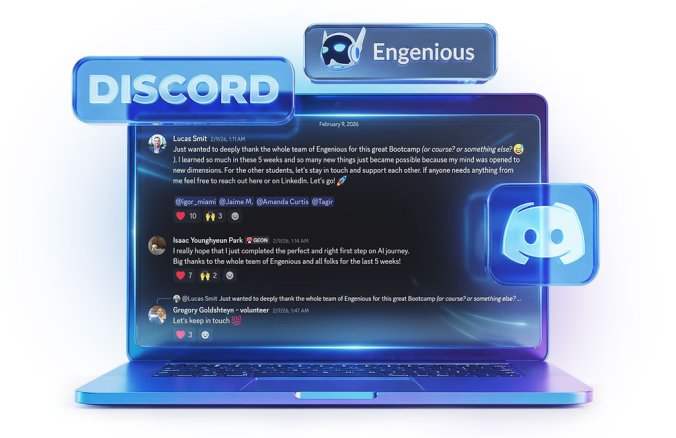
Mentorship, job leads and peer support in a Discord of 1,000+ QA professionals — a network that stays after the cohort ends.
 Job leads
 Community
AI isn't replacing you. It's your next career move.
They Already Made

Dennis Nikolaenko
Prompt Evaluation Engineer @ Meta
“Testing AI and everything that we've been learning so far are very different. AI is smart and we learned how to use it. My message is if I can do it, you can do it.”

Nimesha Shingote
AI QA Engineer @ Infosys
“Even if you are still doing your AI SDLC life cycle in the traditional manner, you will end up testing AI products.”

Mavis Herring
AI Quality Engineer @ WeOptimize AI
“This course built confidence. As soon as I posted that I finished the course on LinkedIn, many recruiters started approaching me.”

Mariia Abramiuk
Senior Quality Assurance Analyst
“It's not just the buzzwords or the theory – it's the actual hands-on experience with red teaming and prompt injection that gives you real confidence to go after this role.”

Lakshmi Navya Sivakoti
AI Tester
“My whole perspective has changed from traditional QA to thinking how I can become an AI Test Engineer or an AI Evaluation Engineer”
Hershal Walton
Gen AI Product Manager
“This course puts you in a leading frontier for new opportunities that should be coming up very soon”
Max Volovich
QA Engineering Manager @ Sirona Medical
“After this course, I not only understand how AI systems work behind the scenes, but I also feel confident leading teams building and testing them.”
Our alumni at







What Keeps Working
Lifetime Community Access

A Discord of 1,000+ QA professionals that stays open after the cohort ends.
Ongoing support from instructors and alumni.
Regular follow-up sessions and career guidance.
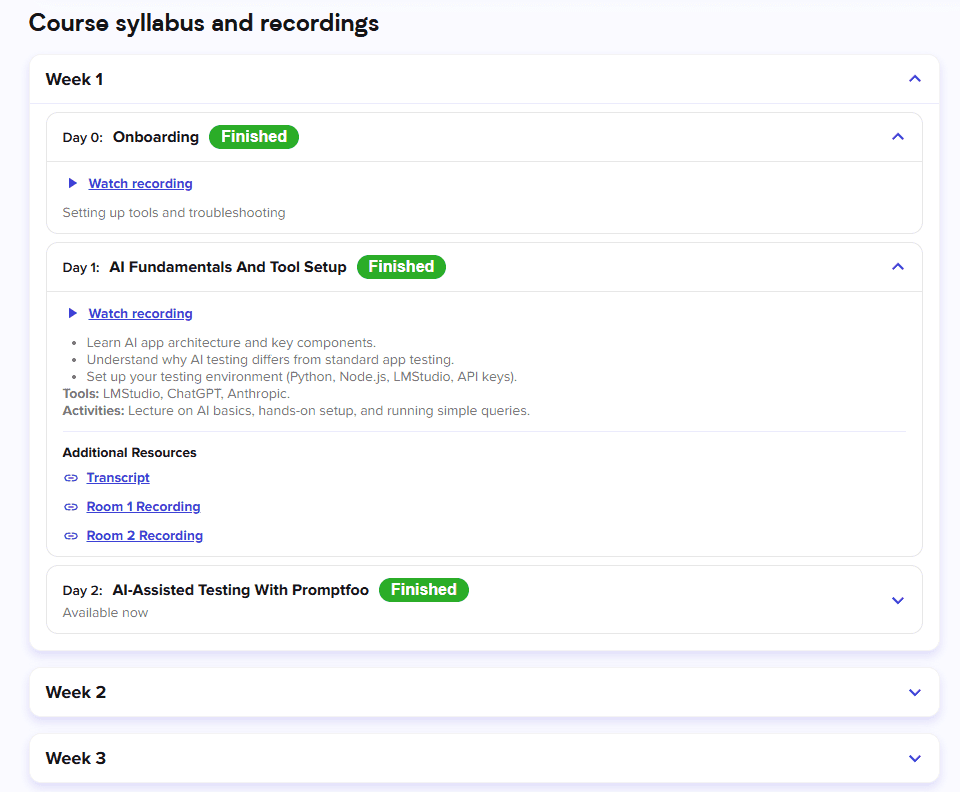
Recorded Sessions
Every session recorded and yours for a year.
Replay the technical demos while you build.
Miss a weekend and you are not behind.
Almost Nobody Can Prove They Can Do The Work.

3,000+ open AI evaluation roles across the US, $98K–$230K+

5–15% of people finish a simple course. 96% finish with our live cohort.

Hiring panels ask what broke, not which course you took.

Someone will own AI testing on your team. Decide it is you.

100% Money-Back Through Week 1
Attend Week 1. If it is not right for you, claim a full refund.
Seats are limited to 50 registrants. Secure your spot today.
What Happens

System

macOS:
Processor: Apple Silicon M1, M2, M3 or M4
Memory: 16 GB RAM (or higher)
Storage: 30 GB free SSD space
Note: Mac OS systems without an M chip are not supported

Windows:
Processor: Intel Core i5 / i7 or AMD Ryzen 5 / 7
Memory: 16 GB RAM (or higher)
GPU: Dedicated GPU with ≥ 6 GB VRAM (e.g., NVIDIA RTX 2060 / 3060)
Storage: 30 GB free SSD space
Yes — at least 1 year of QA experience (manual or automation).
No programming background is needed, though familiarity with testing workflows is helpful.
Submit your application and confirm your eligibility — only 50 seats per cohort are available. Early applicants receive priority for personalized feedback and project pairing.
Not sure if the program is right for you? Book a free AI Career Strategy call before you enroll.
Yes, currently available for U.S. and Canada applicants. May be available for other countries - only for U.S. Dollars payments.
During checkout, you can select a payment plan through Stripe’s Klarna interface, allowing you to spread tuition into manageable installments.
Attend Week 1. If it is not right for you, claim a full refund under the published Week 1 money-back guarantee. The price is the price, however you pay.
AI Career Accelerator is a long term path aimed at full career transformation that offers various courses about AI testing and internship opportunities.
"Break Into AI Testing" - is a first step of AI Career Accelerator path, a 5-week, hands-on training program designed to help QA engineers transition into AI & LLM Testing roles. You’ll work on a real U.S. startup AI project while mastering model evaluation, red-teaming, and test automation with AI tools.
This program is for QA professionals with 1+ year of manual QA experience who want to move into the fast-growing world of AI Quality Assurance. No coding or AI experience is required — just curiosity, analytical thinking, and a testing mindset.
These are addressed through:
- Deterministic & weighted assertions
- LLM-graded accuracy evaluation
- Safety, bias, and hallucination detection patterns
- Multi-model comparison
- Context-based grounding checks
Weeks 2–3 focus on advanced Promptfoo assertions and red-team strategies to identify hallucinations, factual drift, and grounding violations.
You won’t build a RAG pipeline from scratch, but you’ll learn how to evaluate retrieval-augmented systems — a core QA responsibility in AI production environments.
You’ll gain practical skills to:
1. Test and validate AI-powered applications and LLMs
2. Detect hallucinations, bias, and factual drift
3. Evaluate grounding and context reliability
4. Use frameworks like Promptfoo and LLM-graded assertions
5. Build a portfolio-ready capstone project aligned with current job roles
You’ll explore multi-agent orchestration concepts by testing a live AI app.
We emphasize end-to-end testing rather than isolated stages.
You’ll learn to:
✅ Identify failure points in multi-turn interactions
✅ Evaluate guardrail effectiveness and memory behavior
✅ Detect safety leaks and context loss across chained logic
✅ This reflects real QA work in AI product teams — black-box testing of complex reasoning flows.
Yes — these are included through:
- Drift indicators and re-evaluation cycles
- Synthetic variation testing
- Failure pattern analysis
- Feedback loop triage
You’ll learn to identify regression behaviors and emergent defects as AI systems evolve — essential for real-world QA teams.
Week 1: LLM fundamentals, your lab, and your first Promptfoo suite.
Week 2: prompt engineering, cost evaluation, and LLM-as-judge assertions.
Week 3: red-teaming strategy and OWASP Top 10 for AI against a real application.
Week 4: full red-team execution, group bug triage, multi-turn regression, and post-launch monitoring.
Week 5: tool comparison, accomplishment statements, résumé and LinkedIn, and interview prep.
Not in this course. The "Break Into AI Testing" bootcamp focuses exclusively on text-based LLMs, since the current job market is centered on grounding, factuality, and safety validation for text systems.
For alumni, the next step on the AI Career Accelerator path is AI Security Engineer: Red Teaming & Agentic AI Defense — a 5-week specialization covering LLM applications, RAG pipelines, MCP tools, memory and autonomous agents.
1. Project-based learning: You test a real U.S. AI startup product
2. 95% hands-on: Minimal theory, maximum practice — three to four hands-on activities every session
3. Around eight people supporting every cohort: instructors, a host and volunteers rotating between the breakout groups, so you are never stuck alone
4. You leave with artifacts, not notes: a GitHub repository of everything you built, which is what you demo in an interview. Sessions are also recorded and available for a year if you miss one
5. Career coaching and interview prep built into the final week
Nothing is mandatory. The tools we teach on — Promptfoo, LM Studio, Agenta — are free, as are GitHub and Discord.
Two things we strongly recommend, because they make the work considerably smoother:
✅ An Anthropic (Claude) subscription, around $20/month. This is the one we'd push hardest for.
✅ OpenRouter, roughly $10–20, if you want access to less rate-limited models. There is a free tier, but it is throughput-limited, so performance degrades when you are working at pace.
The OpenAI and Anthropic APIs are pay-as-you-go rather than subscriptions — you will need your own key and a small credit balance. Budget around $10 of API credit to start; most students spend little more than that during the cohort.
Every session is recorded and stays available for a year. The program is project-based, so keep pace with the assignments and use the recordings to catch up promptly — most students also revisit them during the internship and while preparing for interviews.
Yes. Join the Engenious Discord and ask graduates directly about the workload, the group labs, the instructors, the internship and the transition. Do not take our word for it.
Yes. You test a real U.S. startup AI product and use that work to build your evaluation report and your portfolio story. The specific product can vary by cohort.
The training is 5 weeks. It includes 10 lectures (40 hours). Classes run Saturdays and Sundays, 10 am – 2 pm Pacific. Sessions typically run four to five hours — we don't cut them short when a group is mid-exercise.
During the week you have homework you complete at your own pace. Plan on 10–12 hours a week in total — four hours Saturday, four Sunday, and the rest weekday lab work.
💻 Windows
✅ Windows 10 (64-bit) or newer
✅ Intel Core i5/i7 or AMD Ryzen 5/7
✅ 16 GB RAM or higher
✅ 30 GB free SSD space
✅ Dedicated GPU with 6 GB+ VRAM recommended for local models (e.g. NVIDIA RTX 2060/3060)
✅ Node.js v18+, Python 3.8+, VS Code, Git (Docker optional)
✅ Chrome or Edge browser
✅ Stable 10 Mbps+ internet + webcam
🍏 macOS: macOS Monterey (12+) or newer
✅ Apple Silicon (M1, M2, M3 or M4) — Intel-only Macs are not supported
✅ 16 GB RAM or higher
✅ 30 GB free SSD space
✅ Homebrew, Node.js v18+, Python 3.8+ (Docker optional)
✅ Chrome or Safari browser
✅ Reliable 10 Mbps+ connection + webcam
Only have 8 GB of RAM?
It is not a dealbreaker. Only Week 1 is affected — the exercise where we run models locally. You can point that exercise at a cloud API instead, which the course uses throughout anyway. Promptfoo, red teaming, Agenta and every live session run against APIs, so they are unaffected by how much memory you have.
That said, if you plan to make a career of building, evaluating or attacking AI systems, plan to upgrade at some point — some roles require running models on your own machine.
💡 Tip: Dual-monitor setups improve productivity for labs and evaluations.
No, and nobody honest can promise one. What we can tell you is what actually happens: on average 38% of our alumni are in a job in the roles we teach within nine months, against an industry benchmark nearer 10%.
Worth understanding why that number isn't higher, because it's the honest part — not everyone who joins is looking for a job. Many enrol to upskill and are happy where they are, and some land roles or promotions and never tell us. 38% is what we can actually evidence.
The entire final week is dedicated to career work — LinkedIn and personal branding, job-search strategy for the AI and QA markets, résumé and portfolio positioning, and interview preparation on the questions actually being asked now. You also start posting from Week 2, so the search is working for you before you finish.
Beyond the cohort, we partner with recruiting agencies specialising in AI evaluation, AI testing and cyber security, and we recommend our top students to them — a recommendation, not a placement. For top-performing graduates, Engenious sometimes offers short-term contract work through partner projects; timing and availability are never guaranteed.
After the programme, instructors stay generally available in our Discord at no cost. One-to-one mentorship sessions are available separately as a paid add-on.
Still have questions?
Not sure if this program is right for you? Need help choosing the best path or want to understand the curriculum better?
We are here to help – just drop us a message and we will respond same day.
MESSAGE US
Ready to begin your ?
The future of QA isn't about choosing between Selenium or Playwright - it's about Mastering Prompt Engineering, LLM Testing and AI Debugging.