AI Threat Modeling
Map attack surfaces across prompts, RAG, memory, tools, identity, MCP servers, model providers, orchestration, and external APIs using OWASP, MITRE ATLAS, and NIST AI RMF.
Become an AI Security Engineer in 5 Weeks
Live (Zoom) • Advanced • 5 Weeks (Weekend sessions)
Part of AI Accelerator
Companies are deploying autonomous AI agents connected to real tools, data and APIs. They need someone who can secure them — and almost nobody can.

Prerequisites
Requirements
YAML, Git, Terminal and APIs
DURATION
5 Weeks (Weekend sessions)
Format
Live, Hands-On Training
Upcoming
Start Date: March 6, 2027
End Date: April 11, 2027
Duration: 5 Weeks
Format: Interactive live Zoom sessions
Pricing
$3,997
$4,997
Early bird price until January 31
or Buy Now, Pay Later with (available for payments in USD)
by paying, you agree to the Terms & Conditions
Course Schedule (PST)
March 6
Saturday
10:00 AM - 2:00 PM
March 7
Sunday
10:00 AM - 2:00 PM
March 13
Saturday
10:00 AM - 2:00 PM
March 14
Sunday
10:00 AM - 2:00 PM
March 20
Saturday
10:00 AM - 2:00 PM
March 21
Sunday
10:00 AM - 2:00 PM
April 3
Saturday
10:00 AM - 2:00 PM
April 4
Sunday
10:00 AM - 2:00 PM
April 10
Saturday
10:00 AM - 2:00 PM
April 11
Sunday
10:00 AM - 2:00 PM
“I know how to test LLMs… but real AI security feels different.”
→ This cohort bridges that gap.
Break Into AI Testing gave you the foundation. You learned how to test LLM outputs, run Promptfoo evals, detect hallucinations, red team prompts, and report AI defects.
The AI Security Engineer cohort takes you to the next level.
You will scope an authorized AI security engagement, connect an assessment harness to a real target, run adaptive multi-turn attacks, verify and reproduce real vulnerabilities, and package confirmed findings into evidence-backed reports and permanent CI regression controls.
This is where you learn to secure the full AI system – not just probe the model response.

This cohort is different because you will run a complete, authorized AI security engagement from start to finish. You will not just test prompts. You will work with:
Master the modern stack of AI Security Engineering.
Map attack surfaces across prompts, RAG, memory, tools, identity, MCP servers, model providers, orchestration, and external APIs using OWASP, MITRE ATLAS, and NIST AI RMF.
Translate a client's business, architecture, and risk priorities into an authorized test plan with scope, boundaries, budget, kill switches, and escalation contacts.
Engineer target-specific Promptfoo cases, plugins, strategies, assertions, graders, skip logic, dual-grader evaluation, and run manifests for AI security assessments.
Test prompt injection, indirect injection, goal hijacking, retrieval poisoning, unsafe tool use, privilege escalation, excessive agency, and identity failures across agents and MCP workflows.
Run controlled multi-turn and sequential red-team episodes that learn from previous responses while staying inside the Rules of Engagement.
Reproduce candidate issues, use multiple graders, challenge findings independently, and package confirmed vulnerabilities with trace evidence, confidence, and AIVSS context.
Convert confirmed vulnerabilities into deterministic Promptfoo regression cases and promote them through human review into CI deploy, change, scheduled, or manual trigger policies.
Generate client-ready assurance reports that separate prepared/static coverage from autonomous agentic discovery, and present findings to both engineering and business stakeholders.
Test retrieval poisoning, document-based prompt injection, data exfiltration, bad citations, groundedness failures, and vector database access controls.

Co-Founder & CTO·WeOptimize.ai
Vladimir is an experienced engineer with 8+ years in software development, specializing in AI-powered solutions. As the Co-Founder & CTO of WeOptimize.ai, he leverages AI to optimize workflows and enhance productivity. He has a track record of delivering innovative products for both startups and large enterprises.

Quality Engineering Manager
Seasoned IT professional with 14+ years of experience in Software Engineering, Quality Assurance, and Automation. Skilled in leading teams, designing test strategies, and building automation frameworks across diverse industries. Adept at leveraging modern tools, AI-driven testing approaches, and cloud technologies to deliver high-quality, scalable solutions. Holds a Bachelor’s in Management Information Systems and a Master’s in Information Technology with proven success supporting enterprise-level clients and Fortune 500 companies.

CEO and Founder
Igor founded Engenious.io and has 15+ years in software testing. He has worked at Barnes & Noble, Expedia and Tinder, and consulted at Apple and Grammarly. He teaches the career week — positioning, outreach and the interview questions companies are actually asking.

Senior AI/LLM Engineer & Consulting
Six years across ML and AI engineering, consulting and teaching. Builds from scratch first for tailored, optimized solutions: agent loops on cloud and local models (official OpenAI, Anthropic and Gemini SDKs; Ollama), and training methods (GRPO, DPO, LoRA, distillation). Uses frameworks where they fit: LlamaIndex and LangGraph for agents; scikit-learn, PyTorch and TensorFlow for ML. Owns the full lifecycle: design, evals, infra as code, CI/CD, deployment on AWS, GCP and Azure, and monitoring that feeds the next iteration. Taught 300+ people in nine cities; trained as an architect.

Award Winning QA Leader
Visionary QA Leader with substantial experience in the IT industry. Worked across Salesforce, Sony, and now as part of Video Engineering and Quality Assurance at Fox Media, he leads the strategy for high-concurrency streaming environments, where a single second of latency is unacceptable.

Software Engineer
10 years of experience in the tech industry; Senior Android Engineer in Platform team. Expert in CI/CD pipelines, test automation, and mobile infrastructure; passionate about developer productivity and workflow optimization.
You will not start from a blank screen. During the cohort, you will work with authorized targets: lab systems you run on your own machine, plus approved staging or intentionally vulnerable environments.
01
Week
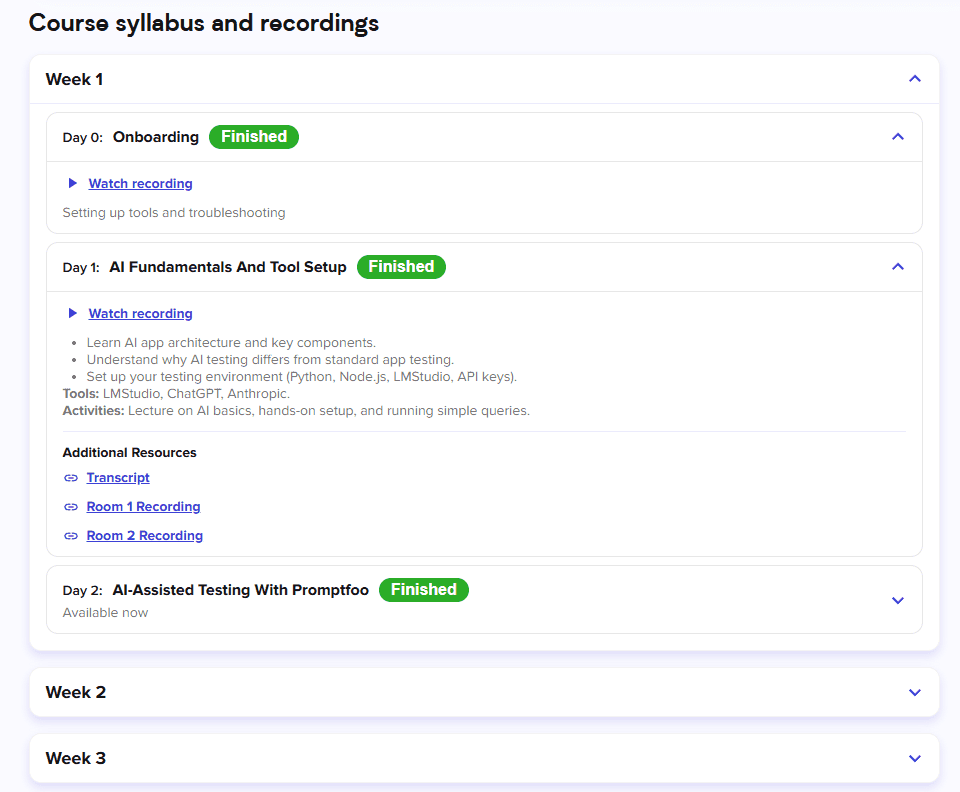
Day 1: Orientation, Foundations Recap & First Red-Team Run
Theme: Get current on the tools, and find out where everyone actually stands.
Theory: What this cohort is building you into, and how the five weeks run. Environment and tooling check. Recap from Break Into AI Testing — Promptfoo configuration, providers, prompts, assertions and model-graded evaluation — then the four settings that are really attack surfaces: tokens and tokenization, the context window, the system prompt, and temperature.
Hands-on: Two paired Promptfoo red-team exercises. Give an AI a narrow job and break it out of its own rules; then audit a higher-stakes agent holding sensitive data and rank what you find by severity.
End-of-Day Deliverable: A working Promptfoo red-team run against a target of your choice, and your first severity-ranked findings list.
Day 2: The Agentic Landscape & Where the Role Sits
Theme: Understand the system you are about to attack, and the market you are about to enter.
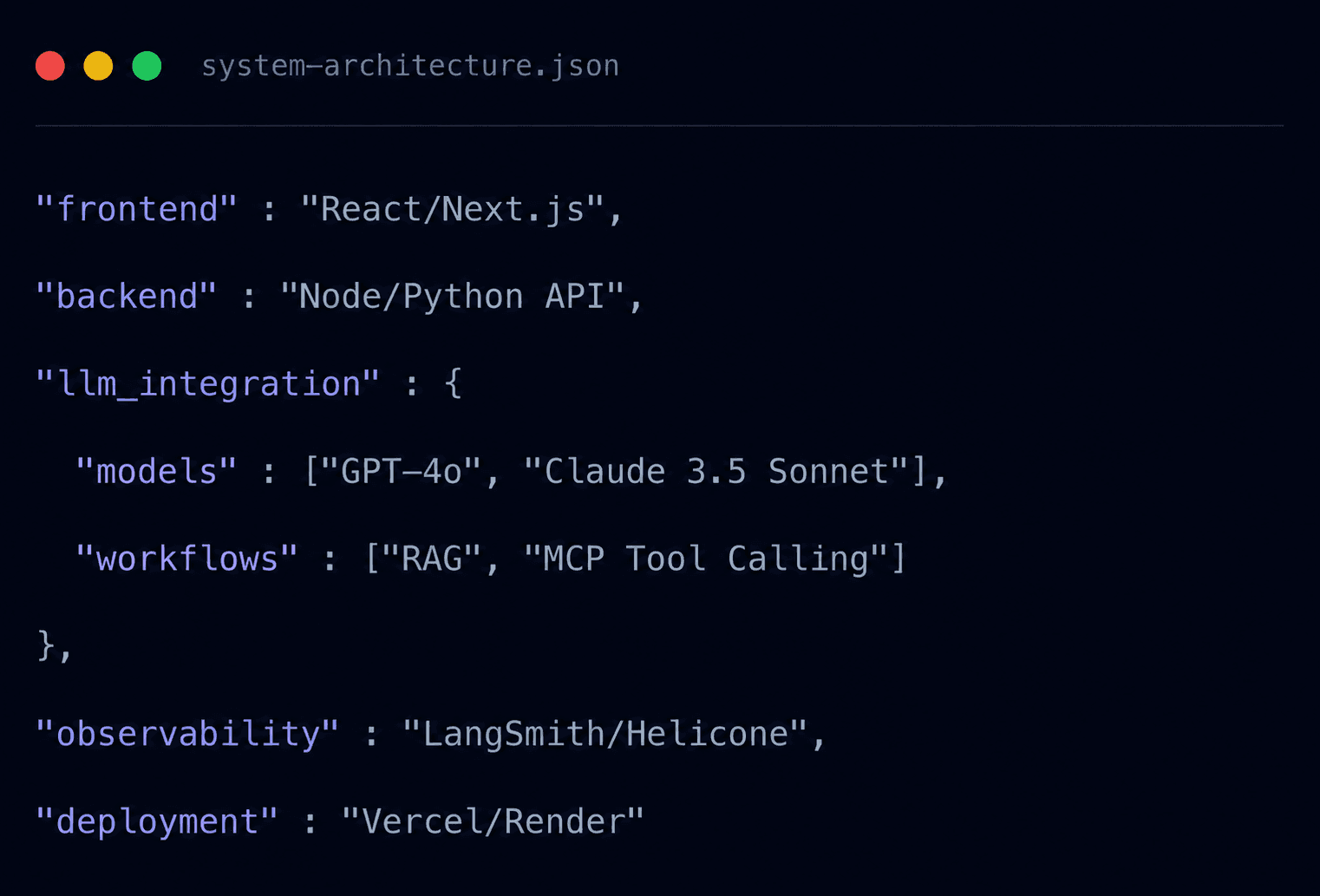
Theory: How we got here — Turing, the AI winters, transformers, GPT, and why prompt injection only acquired a name in 2022. The anatomy of the agentic world: LLM, tool and function calling, MCP, skills, memory, RAG, agent-to-agent protocols, orchestrators, swarms, and recursive self-improvement. Where each one opens a trust boundary — including indirect prompt injection through tool descriptions and shared skill files. Why static, single-turn testing stops working the moment an agent can act.
Hands-on: In pairs, take one agentic scenario — a support agent with MCP tools, a coding-agent swarm, a real-time voice banking agent — and produce three attack surfaces, one concrete test you would run, one production signal you would monitor, and one sentence on why Promptfoo alone will not cover it.
End-of-Day Deliverable: An attack-surface brief for one agentic scenario, plus a shortlist of live AI security roles mapped against your own skill gaps.
02
Week
Day 3: Client Intake, Rules of Engagement & Recon
Theme: Understand the system on paper, get authorized, then check the paper against reality.
Theory: Why CVSS under-scores agents, and how OWASP AIVSS adds agentic factors (autonomy, tool use, memory, dynamic identity and more), scored in a simple first pass. How to run a client intake: business and technical questions asked as a decision tree, not a 100-question form. The OWASP Top 10 for LLM Applications and the OWASP Agentic Top 10 used as a risk checklist. Rules of Engagement: authorization, scope in and out, testing window, limits, kill switch, escalation contacts and evidence handling.
Hands-on: In pairs, read the intake for a fictional retail-bank support agent that has tools, RAG and session memory. State its purpose and the one thing it must never do, shortlist the OWASP risks that apply, and write attack hypotheses ("because it can X, I'll try Y"). Then run the target locally, connect to its API with Postman or curl, and use Claude Code or Codex to map the codebase (recon and fingerprinting).
End-of-Day Deliverable: A risk shortlist and attack hypotheses, a working authenticated connection to the target, and a declared-vs-observed recon table comparing what the client said with what the system actually does.
Day 4: Manual Attacks, Mapped to OWASP
Theme: Attack the agent by hand first. You can't direct an attacking agent until you can do the job yourself.
Theory: CVSS and AIVSS side by side: deterministic code versus probabilistic, tool-using agents. How to write up recon findings with enough evidence that an engineer can trace the cause. Mapping every attack to both an LLM and an Agentic OWASP category. When a failure counts: reproduce it from a clean session and across variations before calling it a candidate finding.
Hands-on: In pairs, build a Promptfoo attack suite against the bank agent, with single-turn and multi-turn cases, covering indirect prompt injection through a help-center article, access to another customer's account, card-number disclosure, moving money without a real one-time code, a chained attack that reuses a leaked secret, system-prompt leakage, and off-topic output. Then review what the AI generated for you: fix brittle assertions, and use LLM rubrics where exact-string checks can't cope with non-deterministic output. Finally, set up the production-style target used later in the cohort: a containerized chatbot web app, a cloud-hosted open-source model, and Burp Suite for request interception.
End-of-Day Deliverable: A category-mapped Promptfoo attack suite with expected-vs-actual results and your first candidate findings, plus the production-style target used later in the cohort running on your machine.
03
Week
Day 5: Building an Attacker AI Agent
Theme: Stop attacking by hand. Run an agent that plans, attacks, judges and learns across runs, then investigate what it finds.
Theory: The six-stage episode loop – Wake, Orient, Plan, Attack, Judge, Reinforce – and the memory that carries hits, misses and lessons from one run to the next, so the agent gets smarter and stops repeating itself. Explore-vs-exploit on attack families (UCB1). Single-turn vs. multi-turn attacks with turn caps. Why you point the attacker's model at a local or open-source one rather than a commercial provider: attacking through a commercial model can get your account banned, and a local or open model also means no rate limits, lower cost, reproducible results, and it works where systems can't reach the internet.
Hands-on: In small groups, run the target agent and the attacker agent in two terminals – first as a fixed script, then wired to a real model (GPT-4o Mini, Mistral, Llama 3.2, run locally or via OpenRouter). Read one full episode, one line per stage, and use Claude Code or Codex to trace the campaign files. Answer: after a family wins, does the planner repeat it or move on, and why?
End-of-Day Deliverable: A running attacker agent producing episodes against the target, a written walkthrough of one episode's six stages, and the attacker model swapped from the fixed script to a live local or open-source model.
Day 6: Closing the Loop – Verify, Gate & Promote to Promptfoo
Theme: Turn candidates into proven findings and wire them into CI/CD.
Theory: Why a candidate isn't a finding until you can reproduce it, and why every re-run starts from a fresh session so context from an earlier run can't fake a leak. The gate that separates a proven finding from noise – three of three by default, or a percentage threshold – as a judgment call where impact weighs as much as frequency: a card number leaking once in a hundred runs is still critical. Promoting confirmed findings to Promptfoo regression files that run in CI/CD, so a bug that's been fixed stays fixed. Shift-left prevention versus incident response. Building a GitHub portfolio hiring teams can read: a branch per exercise, clear commit messages, and one README with a running changelog.
Hands-on: In small groups, add a custom attack strategy to the agent (opening message, follow-ups, family, OWASP IDs, and the goal the judge must prove). Then run the verify step, re-running each candidate several times from fresh sessions; separate confirmed from rejected, read the gate lines (impact, baseline, mitigation, verdict), and decide which findings become Promptfoo test cases, then report the gated findings back to Promptfoo to close the CI/CD loop.
End-of-Day Deliverable: A gated set of confirmed findings promoted to Promptfoo regression files, plus a custom strategy added to the attacker agent.
04
Week
Day 7: Advanced Attacker Agent – AI in Every Stage, Run from a Dashboard
Theme: Take the week-3 attacker and scale it up. It gets more stages and the option of a model at every stage. A dashboard lets you and your team run it without editing code.
Theory: The full ten-stage loop: Wake, Orient, Plan, Attack, Judge, Reinforce, then Verify, Score, Promote, Report. When to add or cut a stage, for example a human-approval step when a client requires one. Each stage runs as code by default and can be switched to an LLM. The anatomy of an attack: the objective (what you must prove, such as a leaked card number or another customer's data), the family (the type of attack, such as access control, sensitive data or encoding), the strategy (the specific approach), the orchestrator (how the conversation unfolds, such as crescendo or ladder) and the converter (how the payload is disguised, such as Base64). How the planner chooses its next attack family, explained as a gambler choosing between slot machines: keep using what has worked, or try something new. It decides from tries and wins. One set of findings, two reports: an executive summary for stakeholders and a technical report for developers. Confirmed findings feed a Promptfoo regression view built into the dashboard. Your GitHub as your portfolio: public repos, a visible commit history, and the attacker you customise as a portfolio piece.
Hands-on: Clone the advanced attacker, start the target and the dashboard, and set up the target and the attacker's model from the UI. Run a campaign twice: once in mock mode (scripted, no API key) and once against the live target. Then verify, score and promote the hits. In groups, pick three findings and name each one's objective, family, orchestrator and converter. Read the planner's priority bars and explain why a family rose or fell. Use Claude Code or Codex to walk through the architecture plan and the strategy matrix.
End-of-Day Deliverable: The advanced attacker run end to end against the target from the dashboard. A written breakdown of one episode: objective, family, strategy, orchestrator, converter and verdict.

Day 8: Make the Agent Yours – Customise, Compare Models, Report the Findings
Theme: If you can't explain a framework, you can't sell it. Make the attacker your own, test what changes when its models change, and turn the results into a report a stakeholder can read.
Theory: Learning an unfamiliar codebase with an AI coding assistant. Start from the architecture and flow, then go down into the detail. Ask for a code review, a glossary and a feature list, and use a second model to put technical answers into plain language. Mock versus live runs, and code versus LLM decision-making: a scripted run scores a hit, but a real model like GPT-4o Mini decodes the Base64 payload, sees the intent and refuses. Choosing a model per stage: small or open-weight models for routine decisions, larger ones for planning. Why companies now send tasks to self-hosted open-weight models or commercial APIs depending on cost. Once you have enough logged runs, a large model's results can train a smaller, cheaper model for one job. Keep one shared technical core and change only the content per target: a set of specialised agents, shaped by the client questionnaire, instead of a new agent for every client.
Hands-on: Show the dashboard and terminal changes you made since Day 7 in peer-led groups. Run Blocks 3 and 4 in mock and live mode, switch stages from code to an LLM, and compare the verdicts. Then gather every finding from the weekend into a stakeholder report and present it. The report has an executive summary, a risk ranking with AIVSS context, and recommendations.
End-of-Day Deliverable: A customised attacker dashboard committed to your GitHub repo. A mock-vs-live comparison of the Block 3–4 runs. A findings report on the target (PDF, slides or HTML), presented to the instructors.
05
Week
Day 9: Attack a New Target – Recon, Fingerprinting & Automated Prompt Injection
Theme: Point everything you've built at a system you've never seen, and stop doing by hand what a script can do.
Theory: Running an engagement against a second target from scratch – read the intake and Rules of Engagement, map the attack surface, then recon and fingerprint the system: model, temperature, context window, whether it uses RAG or tools, rate limits and how it handles odd input. Traditional pen-test tooling on an AI app: Burp Suite to intercept, repeat and modify requests, and an open-source tool that fingerprints the model behind an app from its answers to eight set questions. The OWASP LLM Top 10 (2025 and the new 2026 edition) and MITRE ATLAS as reference catalogs. Manual first, then automate: a runner that sends a file of attacks and logs responses to a CSV, and an LLM-as-judge that labels each one success or fail with a confidence score and a reason – and why a weak judge mislabels, so you verify with a stronger model and a human pass.
Hands-on: In groups, recon and fingerprint the ticketing chatbot through the UI and Burp Suite, run the LLM-fingerprinting tool, work a file of direct prompt-injection techniques by hand, then build a runner that scores the whole file to a CSV and a second script that judges it. Compare judge models.
End-of-Day Deliverable: A recon and fingerprinting write-up of the target, plus your own attack-runner and judge scripts producing a scored findings file.
Day 10: Indirect Injection, RAG Poisoning & Where You Go From Here
Theme: The attacks a user can't see – planted in the data the agent reads – and the start of the real work.
Theory: More injection families against the same target: narrative and role-play framing, and encoding or obfuscation (Base64, spacing, emoji). Indirect prompt injection – hide an instruction inside a support ticket so the agent follows it when it later reads the ticket. RAG poisoning – plant instructions in the knowledge base, re-index, and watch the assistant repeat them. Excessive agency, and testing session memory by reusing a conversation ID and cookie. Combining the runner and judge into one pipeline, and feeding confirmed findings back as regression cases.
Hands-on: In groups, run indirect prompt injection through a planted ticket, poison the knowledge base and re-index, test for memory with a reused cookie, and run narrative and encoding attacks through your scripts. Review every "success" by hand against the real response. Career close: a GitHub portfolio as the thing that gets you found, bug-bounty arenas (Gray Swan) as legal paid practice, and the roles this qualifies you for.
End-of-Day Deliverable: A set of confirmed findings across direct, indirect and RAG-poisoning attacks on the ticketing target, reviewed for false positives and committed to GitHub.
By the end of the cohort, you will have a complete AI security assessment portfolio you can show, explain, and defend in interviews.
Lifetime Community Access
Recorded Sessions


macOS:
Processor: Apple Silicon M1, M2, M3 or M4
Memory: 16 GB RAM (or higher)
Storage: 30 GB free SSD space
Note: Mac OS systems without an M chip are not supported
Windows:
Processor: Intel Core i5 / i7 or AMD Ryzen 5 / 7
Memory: 16 GB RAM (or higher)
Storage: 30 GB free SSD space
Yes. The final part of the course focuses on communicating like an AI Security Engineer. Students prepare a portfolio presentation, practice explaining findings to non-technical stakeholders, review how to talk about the project in interviews, and refine LinkedIn and portfolio positioning.
The goal is for students to leave with practical experience and concrete artifacts they can confidently discuss in career conversations.
A candidate finding must reproduce under defined conditions, pass more than one evaluation method, survive an independent challenge, and include full trace evidence before it can be reported as confirmed. Reporting an unverified candidate as a confirmed vulnerability is an automatic failure condition.
Yes. The final project is the Final AI Security Assessment Portfolio. Students present the system they tested, explain what they built or extended, summarize what they evaluated, share the most important risks they found, show what observability revealed, recommend controls, make a release readiness decision, and share key lessons learned.
The course follows a clear 5-week structure:
Week 1 — Get current and map the agentic attack surface
Week 2 — Scope, authorize and recon a target, then attack it by hand
Week 3 — Build an AI agent that attacks the target
Week 4 — Verify findings and make them permanent
Week 5 — Report, remediate, and defend the capstone
This structure helps students move through the same workflow used in professional AI security engagements: understand the system, test the behavior, document the risk, and communicate the findings.
Yes, for the AI Security Engineer bootcamp you have to either:
- Finish the "Break Into AI Testing" Bootcamp
OR
-Have AI Testing experience of a minimum 6 months
You must be comfortable with the command line, YAML/JSON, Git, and APIs.
Students follow a professional engagement process: scope the system, attack it adaptively, prove the findings, and convert confirmed vulnerabilities into CI regression protection.
Click the link below this FAQ to apply for the next cohort.
Submit your application and confirm your eligibility — only 30 seats per AI Security cohort are available. Early applicants receive priority for personalized feedback and project pairing.
The training is 5 weeks. It includes 10 lectures (40 hours). Classes are held on weekends, Saturdays and Sundays, 10:00 am – 2:00 pm PT. Sessions typically run four to five hours — we don't cut them short when a group is mid-exercise.
During the week you have homework you complete at your own pace. Plan on 10–12 hours a week in total.
Yes — currently available for U.S. and Canada applicants, and possibly other countries for U.S. Dollar payments.
During checkout, you can select a payment plan through Stripe's Klarna interface, allowing you to spread tuition into manageable installments. If Klarna isn't available where you are, or simply doesn't work for you, talk to us — we've set up internal custom payment plans before.
💻 Windows
✅ Windows 10 (64-bit) or newer
✅ Intel i5 (8th Gen +) / AMD Ryzen 5 +
✅ 16 GB RAM (or higher)
✅ 30 GB free storage (SSD)
✅ Node.js v18+, Python 3.8+, VS Code, Git, Docker Desktop
✅ Chrome or Edge, plus Firefox (used with Burp Suite)
✅ Stable 10 Mbps+ internet + webcam
🍏 macOS: macOS Monterey (12+) or newer
✅ Apple M1/M2/M3/M4 chip
✅ 16 GB RAM (or higher)
✅ 30 GB free storage
✅ Homebrew, Node.js v18+, Python 3.8+, Docker Desktop
✅ Chrome or Safari, plus Firefox (used with Burp Suite)
✅ Reliable 10 Mbps+ connection + webcam
⚠️ Use a machine where you can install software. Some company laptops block Docker Desktop.
💡 Tip: Dual-monitor setups improve productivity for labs and evaluations.
The goal is to help students move from AI testing fundamentals to running a complete, authorized AI security assessment.
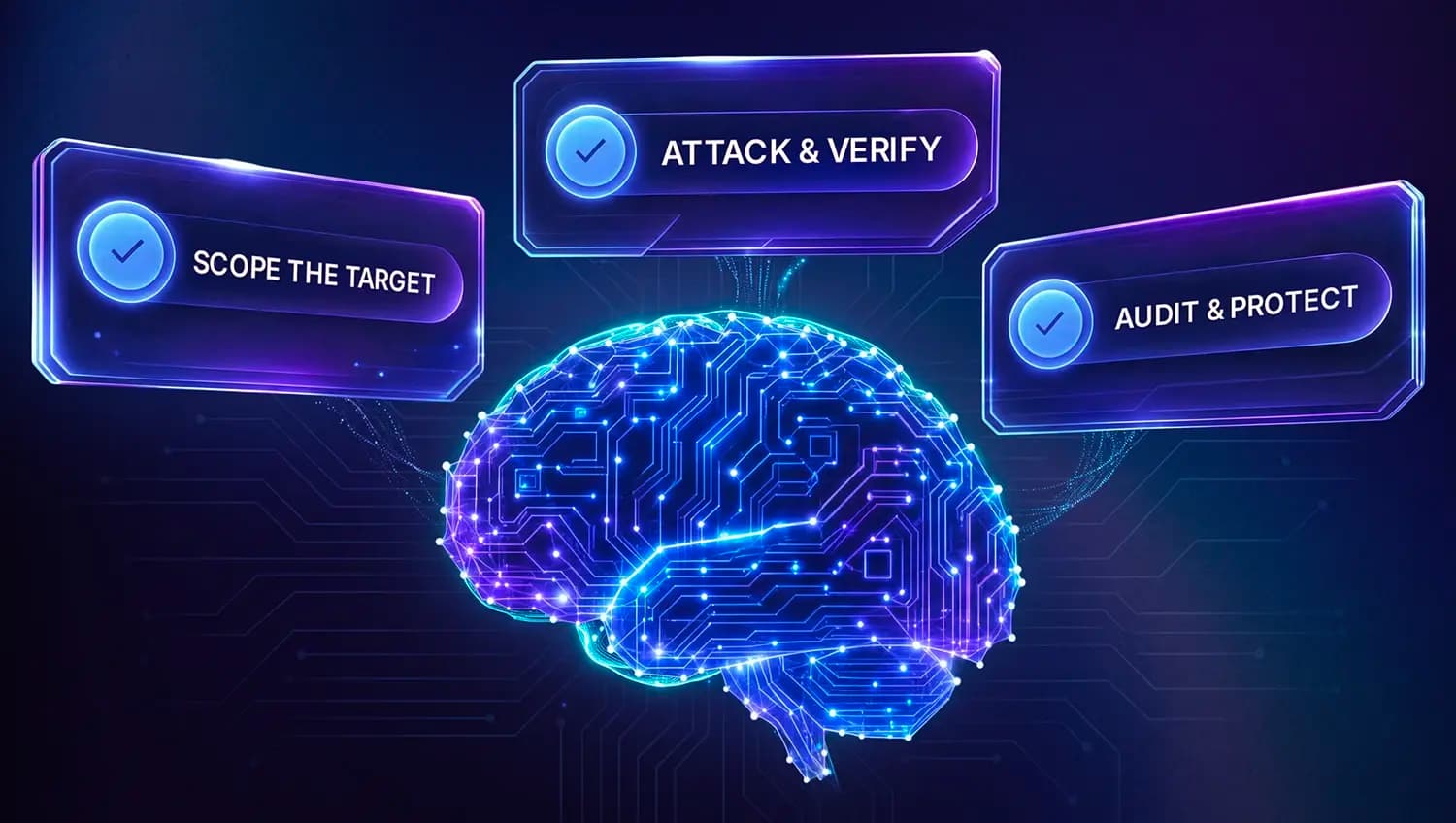
Students follow a professional engagement process: Scope the system. Attack it adaptively. Prove the findings. Protect against regression.
By the end, students will be able to threat-model LLM, RAG, MCP, tool, memory, and agentic attack surfaces; engineer and execute adversarial test suites; verify and score real vulnerabilities; and communicate findings to both technical and business stakeholders.
This course is for students who already understand the basics of AI testing and want to move into AI security and assurance. It is a strong next step for graduates of the Engenious University "Break Into AI Testing" course, QA engineers, SDETs, automation engineers, and security testers who want hands-on experience securing deployed AI systems.
This cohort isn't the right fit if you've never run a Promptfoo eval, or if you're hoping to learn to code here. From Day 1 you need to be comfortable in the command line, with YAML/JSON, Git and APIs.
If that isn't you yet, start with the "Break Into AI Testing" bootcamp. It's built to get you there.
This course can support students preparing for roles or responsibilities related to:
The course is especially useful for professionals who want to show proof that they can test more than simple prompts. Students learn to evaluate deployed AI systems across architecture, API behavior, RAG, tool calling, red teaming, observability, and risk.
Promptfoo is the primary assessment and regression framework. Alongside it you work with an AI coding assistant (Claude Code or OpenAI Codex), Postman and curl for connecting to targets, Docker for running lab targets locally, Burp Suite for intercepting requests, and Ollama for open-source models on a cloud GPU host. Later weeks add tools such as PyRIT, garak, Langfuse-style observability and tracing, Git-based review workflows, and CI/CD pipelines. The exact tools may vary by cohort, but the goal is consistent: students learn to audit a real AI system using a professional security engagement process.
Not necessarily — there are two routes in. Either complete our "Break Into AI Testing" bootcamp, or bring at least 6 months of hands-on AI testing experience.
Students who completed the first Engenious University AI Testing course are well prepared, because this cohort builds on a foundation in AI testing, LLM behaviour, prompt evaluation, hallucination testing and red teaming basics.
If you already work with Promptfoo, red teaming and LLM evaluation and want to come straight into the AI Security Engineer cohort, book a call with us and we'll work out whether it's the right fit.
Prior security experience is helpful but not mandatory. You must be comfortable with QA fundamentals and ready to work with threat modeling, authorization boundaries, identity, secrets, cloud controls, and evidence handling. You will also need to be comfortable in the command line, with YAML/JSON, Git, APIs, and modifying small Python or JavaScript scripts.
No. All exercises require explicit authorization and use approved staging or intentionally vulnerable targets. Real customer data is never part of a student lab.
The first course teaches the foundations of AI and LLM testing — prompt testing, assertions, Promptfoo, red teaming concepts, bug reporting, and career positioning.
This cohort focuses on professional AI security engagements. Students learn to scope an authorized assessment, connect an evaluation harness to a real target, threat-model agentic attack surfaces, run adaptive multi-turn red teaming, verify and reproduce real vulnerabilities, communicate risk to stakeholders, and convert confirmed findings into CI regression protection.
The core tools you work with (Promptfoo, PyRIT, garak) are free, as are GitHub and Discord. Beyond that, plan for a few running costs:
✅ An AI coding assistant, around $20/month: Claude Code (Anthropic) or OpenAI Codex. Sessions are taught on the assumption you have one.
✅ Model API credit, around $10 to start. The OpenAI and Anthropic APIs are pay-as-you-go rather than subscriptions, so you will need your own key and a small credit balance.
✅ A cloud GPU host for open-source models, around $10 of credit. Pods bill by the hour (roughly $1/hour), so you start one for a lab and stop it when you are done.
✅ OpenRouter, roughly $10–20, optional, if you want access to less rate-limited models. There is a free tier, but it is throughput-limited, so performance degrades when you are working at pace.
Yes, across both live bootcamps. Break Into AI Testing covers reliability directly — grounding and context checks, factual drift, multi-turn conversation failures — and introduces red teaming against the OWASP Top 10 for LLM applications. The AI Security Engineer bootcamp goes further into safety assurance: threat modelling with OWASP AIVSS, MITRE ATLAS and the NIST AI Risk Management Framework, adaptive red teaming of agentic systems, and converting confirmed findings into CI regression protection.
It addresses ethics as testing practice rather than as theory. You test for the failures that cause ethical harm: hidden bias and discriminatory output, compliance breaches where a model gives advice it is not permitted to give, and value misalignment where a model produces answers no company would approve. The AI Security Engineer bootcamp adds professional conduct — written authorization, Rules of Engagement, scope boundaries and evidence standards, with all testing done against approved staging or deliberately vulnerable targets, never live production systems.
Still have questions?
Not sure if this program is right for you? Need help choosing the best path or want to understand the curriculum better
We are here to help – just drop us a message and we will respond same day.
MESSAGE USScope it
Attack it
Prove it
Protect it.
That is the operating process of an AI security practitioner – and what you will practice in every session of this cohort.
Ready to Become an ?
If you completed Break Into AI Testing and want to move into AI security and assurance, this is your next step. Join the AI Security Engineer cohort and learn how to scope, red team, and protect real AI systems.